
Fog Between the Panes
Clear the View Without Automatically Replacing the Whole Window
Fog or moisture trapped between double-pane or triple-pane glass usually points to a failed insulated glass unit. The panes, spacer and edge seals are manufactured as one sealed assembly, commonly called an IGU or sealed unit.
When the existing frame and sash remain stable, Glass Repair Canada can often replace the failed glass unit while keeping the surrounding window in place.
- Double-pane sealed units
- Compatible triple-pane units
- Low-E replacement options
- Glass-only replacement
Condensation Finder
Where Is the Moisture Located?
The location of the condensation is the first clue. Open each option to understand whether the glass unit may have failed. Our cloudy double-pane window guide walks through the surface check before you choose cleaning or glass replacement.
On the Room-Side Surface
The moisture can be wiped from the glass inside your home.
What it may mean: Indoor humidity and a cold glass surface can create accessible condensation. This alone does not prove the sealed unit has failed. If that water collects on the sill, our guide to cleaning mould off window sills separates room-side moisture from a failed seal.
Review ventilation, humidity and whether the moisture disappears when the surface is wiped.
On the Exterior Surface
The moisture appears outdoors and can be wiped from outside.
What it may mean: Exterior condensation can occur when the outside glass surface becomes cooler than the surrounding humid air.
It is not the same as moisture sealed between two panes.
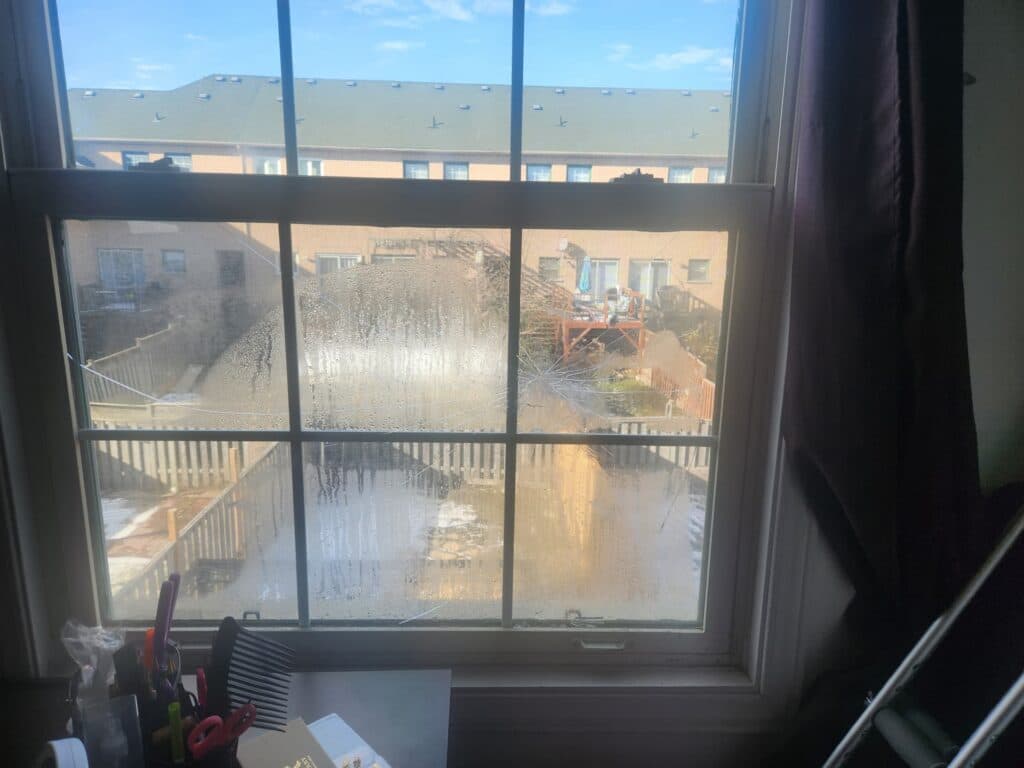
Trapped Between the Panes
The haze cannot be wiped from either accessible surface.
What it may mean: Moisture has entered the cavity between the panes after the edge seal or complete insulated glass unit failed.
A measured replacement IGU is often the reliable glass-only solution.
Inside the Glass Unit
Why a Failed IGU Becomes Foggy
An insulated glass unit is the complete assembly of two or more panes separated by a spacer and sealed around the edges. The cavity between the panes is intended to remain isolated from indoor and outdoor moisture.
When the edge-seal system fails, humid air can enter the cavity. Changes in temperature can then turn that moisture into haze, droplets or mineral staining between the panes.
Exterior Pane
The outside pane forms the exterior-facing side of the insulated glass assembly.
Sealed Cavity
The space between the panes may contain dry air or gas, depending on the unit specification.
Spacer and Edge Seals
The spacer separates the panes while the edge-seal system closes the complete glass assembly.
Interior Pane
The inside pane faces the room while remaining part of the same manufactured sealed glass unit.
Common Progression
How a Failed Sealed Unit May Change Over Time
The appearance can change with the weather and temperature. Fog may disappear temporarily and return without the underlying failure being resolved.
Intermittent Haze
Light fog appears during particular weather or temperature conditions.
Recurring Condensation
The haze returns more often and becomes harder to ignore.
Visible Droplets
Moisture begins collecting into beads or streaks between the panes.
Persistent Staining
Mineral residue or lasting cloudiness may remain inside the sealed unit.
Match the Problem
Different Moisture Problems Need Different Solutions
Cleaning, frame sealing and insulated glass replacement solve different issues and should not be treated as interchangeable services.
Surface Condensation
Moisture is on a surface you can reach and wipe. Indoor humidity, airflow, exterior weather and glass temperature may be involved.
Frame or Perimeter Issue
Drafts, visible gaps or water entry appear around the surrounding window rather than only inside the sealed glass cavity.
Moisture Between Panes
The haze cannot be wiped from either side because it is trapped inside a double-pane or triple-pane insulated glass unit.

Replace the Failed Unit
You May Not Need a Completely New Window
If the frame, sash and operating hardware remain serviceable, the failed insulated glass unit can often be removed and replaced independently.
The replacement unit is prepared according to the opening’s width, height, overall thickness, pane count, spacer, coatings and compatible glass specification.
What May Stay
- Existing window frame
- Serviceable sash
- Interior trim
- Compatible operating hardware
What Is Replaced
- Failed sealed glass assembly
- Damaged edge-seal system
- Moisture-filled cavity
- Associated spacer within the unit
For a broader comparison, read our guide about window repair versus complete window replacement.
Replacement Specifications
Insulated Glass Options for Compatible Windows
The new sealed unit must match the existing window system rather than being selected by appearance alone.
Double-Pane IGU
Two panes separated by a spacer and manufactured as one sealed glass assembly.
Triple-Pane IGU
A three-pane unit must match the sash depth, total thickness and existing window design.
Low-E Replacement Unit
Compatible Low-E coatings can be matched after the existing orientation and glass specification are confirmed.
From Foggy to Clear
How Sealed-Unit Replacement Works
The replacement is measured for the existing opening before the failed glass assembly is removed.
Locate the Condensation
We determine whether the moisture is on an accessible surface, around the frame or trapped between sealed panes.
Inspect and Measure the Unit
The frame and sash are checked before recording the glass dimensions, total thickness, pane count, spacer and coatings.
Prepare the Replacement IGU
The sealed unit is prepared to match the confirmed opening and compatible glass requirements.
Remove, Install and Check
The failed unit is removed, the opening is prepared and the replacement is installed, sealed and checked.
Starting Rates
Foggy Window Repair Pricing
Final pricing depends on the glass dimensions, pane count, coatings, access, spacer and condition of the surrounding window system.

Full IGU Replacement
For failed double-pane or compatible insulated glass units
Moisture Venting
Condition-specific appearance treatment
Frame Perimeter Resealing
For accessible exterior or frame-perimeter gaps
Specialty Spacer or Edge Work
Only where the unit and glazing system permit appropriate servicingSee What Our Clients Say
We’ve made some big promises – and we deliver.
See what our customers have to say through real reviews and video testimonials.




The team was super friendly and professional — you can tell they really care about doing good work. Definitely recommend them to anyone who needs glass or window repairs. Thanks again, guys! 🙌



Was amazing they come on time to replace commercial glass everything was so clear from start to finish


Strongly recommend!

Thanks


it's was a great experience working with you

Simon and Adil were excellent and professional. I had my window in less than a week, very happy and would recommend to anyone!
Will use them again for another
project!
Excellent quality and professional service from glass Repair Canada they fixed our bedroom window so quick! Quick, great quality, Called second time for 3 shower doors on my second floor! Definitely will recommend to family and friends
Alex and his team did an amazing job replacing my old and aging patio door. I got a fair qoute and he explained the entire proccess in detail. On the day of the installation they areived on time and did a remarkable job, it looks beautiful now!
What a great crew. Swift, efficient, Professional and cost efficient.
Im very impressed!
I was back in business
in no time!

Foggy Window Myths
What Common Quick Fixes Can and Cannot Do
Foggy glass is often misunderstood because several different condensation problems can look similar.
“Exterior silicone will clear moisture between the panes.”
“A foggy pane means the complete window must be replaced.”
“All window condensation means the seal has failed.”

Glass Repair Canada
A Glass-Focused Diagnosis Before Recommending Replacement
The goal is to identify whether the issue is surface condensation, frame-perimeter leakage or failure inside the insulated glass assembly.
Locate the Moisture
We distinguish accessible condensation from moisture sealed between the panes.
Preserve Serviceable Frames
Glass-only replacement is considered when the sash and frame remain suitable.
Match the Existing Unit
Dimensions, overall thickness, pane count, coatings and spacer requirements are confirmed.
Explain the Difference Between Options
Cosmetic moisture treatment, frame sealing and full IGU replacement are presented as different services with different outcomes.
Mobile GTA Service
Foggy Window Service Across Toronto and the GTA
Our mobile service supports homeowners, landlords, condominium residents and property managers throughout Toronto and surrounding communities.
Photos That Help
Send one photo of the complete window, one close-up of the fog or condensation, and another showing the surrounding frame and sash.
Common Questions
Foggy Window Repair FAQs
Why is there condensation between my window panes?
Condensation trapped between panes usually indicates that the edge-seal system of the insulated glass unit has failed and moisture has entered the sealed cavity.
Can a foggy window be repaired without replacing the whole window?
Often, yes. If the frame and sash remain stable and serviceable, the failed insulated glass unit may be replaced while the surrounding window remains in place.
Does moisture venting restore the original insulated glass seal?
Moisture venting may improve appearance in some situations, but it does not recreate the original factory-sealed cavity or make the service equivalent to a new insulated glass unit.
Will exterior caulking remove condensation between the panes?
Exterior perimeter caulking may address gaps around the frame, but it does not remove moisture already trapped inside a failed sealed glass unit.
Can you replace Low-E or triple-pane insulated glass?
Compatible Low-E, double-pane and triple-pane units may be replaced after the dimensions, thickness, coatings, spacer and existing window system are confirmed.
Does exterior condensation mean the window seal has failed?
Not necessarily. Condensation on an accessible interior or exterior surface can be related to humidity, surface temperature and weather. Moisture trapped between sealed panes is the stronger sign of IGU failure.
Request an Estimate
Get a Quote for Foggy Window Repair
Tell us whether the moisture can be wiped from the surface or appears trapped between the panes. Photos of the complete window and surrounding frame can help with the initial assessment.