
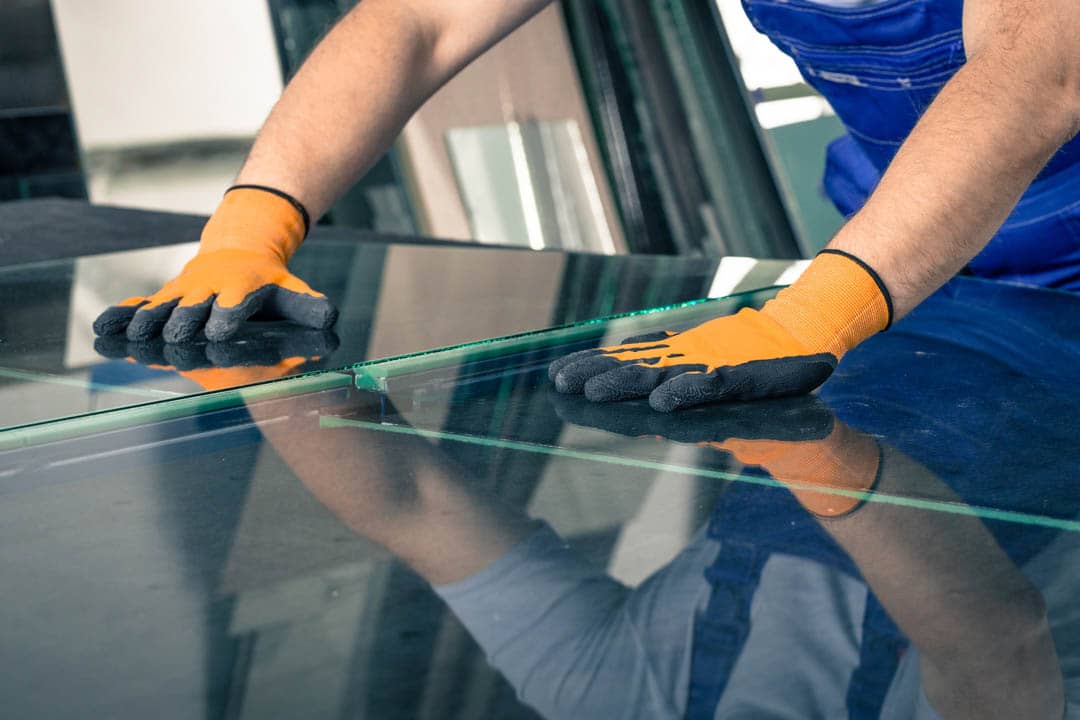
The main benefits of glass doors inside a home are shared daylight, an open view and the ability to separate rooms without making them feel disconnected. They can work especially well between a living area and a home office, where you want a boundary but still value a visual connection.
The right door also needs to suit privacy, sound and everyday movement. This guide focuses on interior glass doors. Exterior entrances have additional weather and security demands, covered in our front-door guide and patio-door guide.
Check the light path
View the opening when the room is in use. Clear or partly obscured glass can pass available light, but the door cannot create daylight in an unlit adjoining space.
Test the sightline
Use a sample at the proposed height with someone seated and standing behind it. Check both lighting directions and any clear borders.
Review the whole room
Ask for tested assembly information covering the door, frame and seals. Also consider sound through walls, vents and other routes. Frosting is not a speech-privacy specification.
Check light control
A frosted door can still admit hallway light. Compare a suitable covering or a different door if sleep or screen work requires darkness.
A planning prompt, not a product recommendation, acoustic calculation or compliance check.
Share daylight with an adjoining room
A glazed door can carry light from a brighter room into a darker hallway or workspace. In a deep Toronto home, that may make an internal room more pleasant to use without opening up the entire wall.
The result depends on where daylight comes from, the size of the glass and the view through the adjoining space. A glass door cannot create daylight where neither room receives it. Check the opening during the hours you normally use the room, not only at the brightest time of day.
Light is also a trade-off. A glazed bedroom door may admit unwanted hallway light at night, even with an obscuring finish. If darkness is important for sleep or screen work, include that requirement before choosing the glass.

Keep spaces visually connected
Clear glass lets you see between rooms when the door is closed. That can make a small office feel less cut off, preserve a view through the home or let you notice activity without leaving the room.
Think about what will actually be visible. A view toward bookshelves may be welcome, while a direct view of a computer screen or an untidy utility area may not be. Furniture placement and selective obscuration can sometimes solve the issue without covering the entire pane.
Choose an opening style that supports the layout. A sliding door can avoid a swing into a compact room, while paired hinged doors may open the spaces more fully when privacy is not needed. Our glass-door styles guide compares the space each mechanism requires.
What people can see
Use privacy finishes deliberately
Frosted glass door privacy is primarily about obscuring the view. It does not automatically provide darkness or stop conversations being heard. Patterned and textured glass also vary in how much detail remains visible.
Test a sample with lights on in each room and someone standing at realistic distances from it. Look from both sides. A finish that hides a person across the room may still show a silhouette close to the door, and clear borders can leave unwanted sightlines.
For a home office, a frosted band might screen the desk while retaining light above it. For a bedroom, the household may need a more substantial light-control solution. State those needs separately rather than asking for privacy as if it were one property.
What people can hear
Set realistic expectations for sound
Glass door sound insulation depends on the whole assembly, including the panel, frame, perimeter seals and gaps. On paired doors, the meeting edge is another important junction. Sound can also travel through surrounding walls, vents and other routes.
A decorative pattern does not provide acoustic performance. If confidential calls or undisturbed sleep matter, request tested information for the actual door assembly and discuss the room around it. A glass-only rating cannot tell you what a loosely sealed installed door will achieve.
Echo inside a room is a different problem from sound travelling into the next room. Rugs or soft furnishings may make a hard-surfaced room sound less lively without making conversations private. Identify which result you need before spending on a door or an acoustic treatment.
For background on direct and indirect sound routes, see the National Research Council’s explanation of sound transmission between rooms.
Glass doors for a home office: a useful test case
Decide how the office works during a normal day. Do you want to see family activity while concentrating, close the door for occasional calls or prevent speech from being understood outside? Each goal points to a different combination of glass, seals and layout.
Place the desk so screen reflections and sightlines are manageable. Check whether a hinged leaf blocks a chair or whether a wall-mounted slider has enough parking space. If sound separation is important, compare systems designed to close against appropriate seals rather than choosing an open-edged appearance first.
A door that feels comfortable to operate is more likely to be used as intended. Try the handle and closing action, and check the route with the door fully open and closed.
Keep the finish and care routine manageable
Glass offers a smooth surface, but fingerprints, pet marks and smudges can be visible. Glass door maintenance includes the hinges, pivots, track, handle and seals as well as the pane.
Follow the product's cleaning instructions, especially for coatings, frosting or applied decorative finishes. Use compatible cleaners and tools rather than assuming one household glass cleaner suits every surface. Check how you will reach both faces, edges and tracks without moving heavy panels.
Ask whether wear parts and replacement glass will be available. If the door begins rubbing, dragging or failing to latch, have the fault assessed before it leads to further damage. Cracked or chipped glass needs a safety assessment, not a cosmetic cleaning treatment.
Plan safe movement through the doorway
The glass and hardware must be appropriate for the door's intended use. Clear panels also need to be noticeable to the people using the space; consider suitable visible handles or design markings where an otherwise transparent door could be overlooked.
Check swing clearance, handle reach and the threshold or floor guide. Include children, pets and anyone using a mobility aid in the layout discussion. Avoid improvised changes that interfere with closing, latching, ventilation or an escape route.
Where the doorway is part of a required fire separation or another regulated assembly, confirm the replacement requirements before changing it. An ordinary decorative glass door is not automatically suitable for every opening in a house or condo.
Questions before you decide
Does frosted glass make a home office soundproof?
No. Frosting changes what can be seen through the glass. Speech privacy depends on the complete door, frame, seals and other sound paths around the room.
Can an interior glass door make a dark room brighter?
It can share available light from an adjoining room. The result depends on the light source, glazed area and layout; it cannot create daylight where neither room receives it.
Is a sliding glass door always the best choice for a small room?
A slider avoids a hinged swing, but still needs space for the moving panel and accessible hardware. Compare the clear passage, parking space and sound-sealing arrangement for the actual model.
Is an interior glass door the right choice?
It is a strong option when shared light and a visual connection are useful, and when privacy requirements can be met by the selected assembly. It may be less suitable where complete darkness or strong speech privacy is the overriding goal and the proposed product cannot deliver it.
For an existing residential door with damaged glass or operating problems, Glass Repair Canada offers glass-door repair. Send photos of the door and hardware, your Toronto or GTA location, and a clear description of the fault. That makes it easier to decide whether glass, hardware or a wider change is the appropriate next step.
Discuss an existing glass door